
Fifteen minutes from Heathrow to Paddington is a genuinely impressive number, and it is also the most misleading figure in London airport travel. It is true, it is verifiable, and for most passengers it describes rather less than half of the journey they are actually making. Paddington is not a destination; it is a station on the western edge of central London, and what happens after you arrive there is the part nobody advertises. This guide compares the rail options from Heathrow against a pre-booked car, honestly, including the cases where rail wins outright and we would tell you to take it. It covers the Heathrow Express, the Elizabeth line and the Piccadilly line, what each is genuinely good at, how the arithmetic changes with a second passenger, and the specific circumstances that decide it: luggage, the hour, the destination and whether anyone is meeting you at the other end.
Three rail options, not one
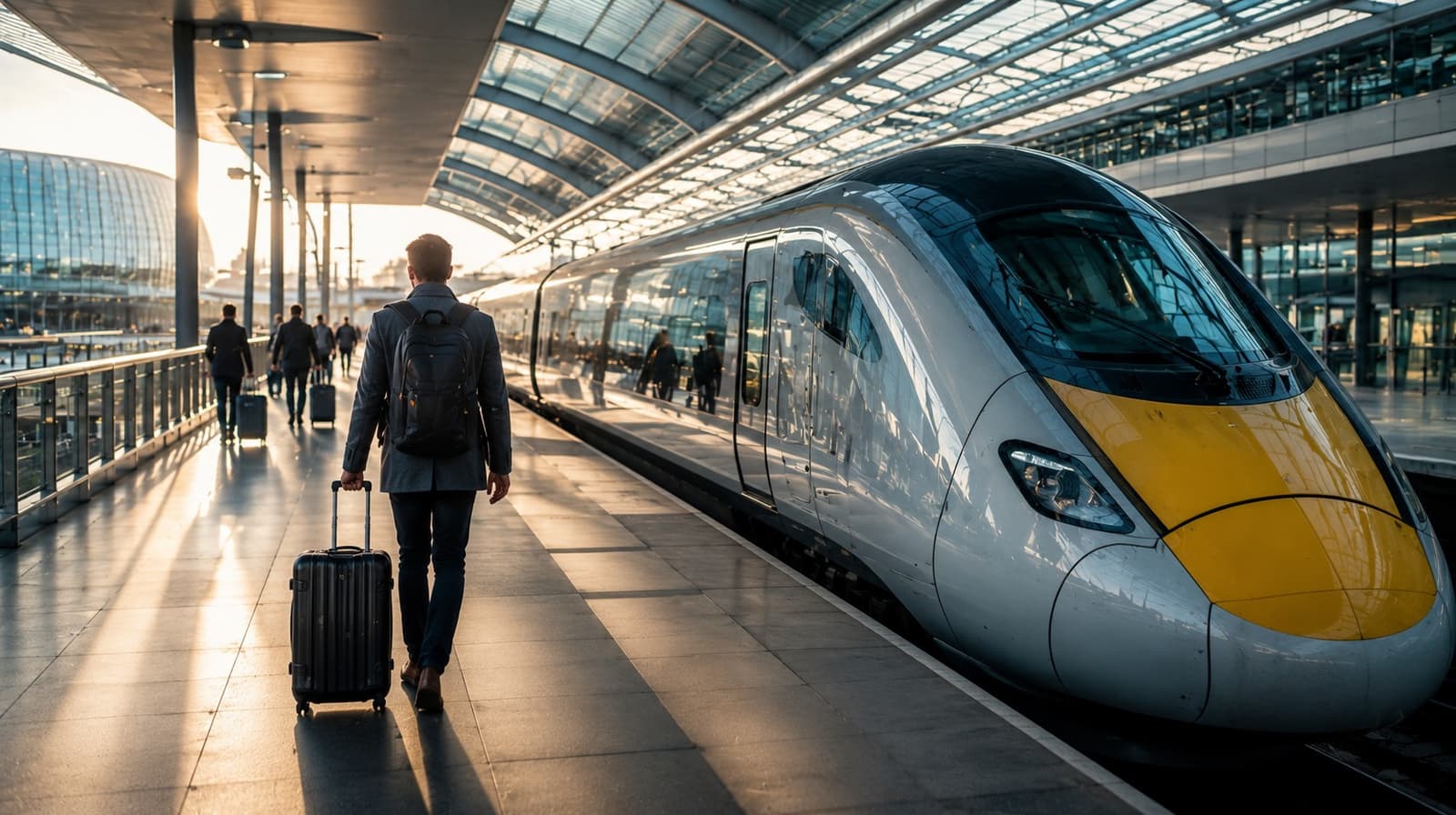
People say "the train" as though there is one, and the three differ enormously. The Heathrow Express is the fast one, running non-stop to Paddington in about fifteen minutes, several times an hour, from a dedicated platform. It is the most expensive rail option by a considerable margin and it is worth it if Paddington genuinely suits you. The Elizabeth line takes roughly half an hour to Paddington but keeps going east through the centre, which is the important difference: it reaches Bond Street, Tottenham Court Road, Farringdon, Liverpool Street and Canary Wharf without a change. It costs a fraction of the Express. The Piccadilly line is the cheapest and slowest, taking around an hour into the centre with many stops, and it involves stairs at a number of stations, which matters with cases. Choosing between them is really choosing where you want to be deposited, and that is the question that decides the whole comparison.
The last mile is the whole argument
Every rail journey from Heathrow ends at a station, and almost nobody is going to a station. What happens next is the part that decides whether rail was the right call, and it takes one of three forms: a walk, a taxi, or the Underground with your luggage. If your destination is within a few minutes' walk of Paddington, or of an Elizabeth line station, rail is excellent and the case is closed. If it is not, you are adding a leg. A taxi from Paddington to Mayfair is short but it is another fare, another wait and another set of decisions after a flight. The Underground with two suitcases at rush hour is genuinely unpleasant, and many stations have no lift. A car has no last mile at all: it stops outside the address you gave when you booked. That is the entire proposition, and whether it is worth paying for depends almost entirely on how far your destination sits from a platform. Our Heathrow to central London transfers are priced by that destination rather than by the terminal you land at.
The arithmetic with a second passenger
Rail fares are per person and a car is priced per vehicle, so the comparison moves sharply with each traveller you add. One person travelling light to Paddington is comfortably better off on the Express. Two people are already paying two Express fares plus, in most cases, an onward taxi, and the gap narrows to the point where it becomes a judgement rather than an obvious saving. Three or four passengers changes it again, because the car fare has not moved at all while the rail cost has tripled or quadrupled and the practical difficulty of moving a group with luggage through two stations has grown considerably. Families rarely find rail cheaper once children are counted, and never find it easier. The rule of thumb is straightforward: at one passenger, price favours rail; at two, it is close; at three or more, the car usually wins on cost as well as on everything else.
Luggage decides more journeys than price
A single cabin bag makes rail entirely practical. Two large suitcases make it an ordeal, and the ordeal is worst precisely where the timetable is best. Consider what the rail journey actually asks of you with real luggage: getting cases to the platform at Heathrow, lifting them onto the train, finding rack space that may already be full, retrieving them at Paddington, then either walking, queuing for a taxi or navigating the Underground where lifts are the exception rather than the rule. Do that after a long-haul flight and the fifteen minute figure stops feeling relevant. On a private booking the driver takes the heavy cases at the point you meet, loads them, and they do not move again until your address. If you are travelling with more than hand luggage, this consideration usually outweighs the fare difference on its own.

The hour matters more than people expect
Timetables shrink at both ends of the day, and that is when travellers most need them not to. Rail services from Heathrow do not run through the night, so a flight landing after the last departure leaves you with no rail option at all, and a pre-dawn departure may be earlier than the first service. This catches people out regularly, because the timetable they checked was the daytime one. Rush hour cuts the other way. A train at eight in the morning is fast and crowded, and standing with suitcases in a full carriage is not a pleasant end to an overnight flight. A car in the same conditions is slower but you are sitting down and your bags are in the boot. The general pattern is that rail is at its best in the middle of the day in good conditions with light luggage, and at its worst exactly when a journey is already difficult: very early, very late, in bad weather or when you are tired.
Where rail genuinely wins
We would recommend the train without hesitation in several cases, and it would be dishonest to bury them. A solo traveller with hand luggage going to Paddington or an Elizabeth line station should take the train, and the Express if speed matters more than cost. Anyone travelling in the middle of the day whose destination is a short walk from a platform should take the train. Anyone on a tight budget with time to spare should take the Piccadilly line and think nothing of it. Rail is also more predictable than the road in one specific way that deserves credit: a train is not affected by traffic. If the M4 has an incident, a car journey can extend considerably while the Express runs exactly to time. That reliability is real, and for a traveller with a tight onward connection from Paddington it is a legitimate reason to choose rail over a car regardless of everything else in this article.
Where a car wins clearly
The reverse cases are equally specific. Two or more passengers, especially with luggage. Any destination that is not near a station, which includes much of south and west London, the Docklands beyond the Elizabeth line stops and everywhere outside the capital. Arrivals after the last train and departures before the first. Anyone with limited mobility, and anyone travelling with children, for whom two stations with cases is a genuinely bad plan. There is also the arrival itself. On a car booking your driver waits inside the terminal with a name board, takes the bags and walks you to the vehicle, and the free waiting period runs from touchdown rather than from your scheduled arrival, which covers the immigration queue. Nobody meets you at a railway platform. For a client you are collecting, for a relative who does not know London, or for yourself at the end of a fourteen hour flight, that difference is the product. We describe the full sequence on our page for chauffeur collection at Heathrow.
Canary Wharf and the east
One destination deserves separate treatment because the answer changed recently. The Elizabeth line runs directly from Heathrow to Canary Wharf without a change, which removed the old problem of crossing London by Underground with luggage. For a single business traveller with a cabin bag, that is now a strong option and frequently the sensible one. The car still wins in the familiar circumstances: more than one passenger, real luggage, an early or late arrival, or a destination that is a specific tower rather than the station. Canary Wharf is a privately managed estate where buildings are known by name and vehicles use designated set down points, so being delivered to your building's own entrance is worth more than being delivered to the district. If you are heading there regularly it is worth knowing both routes and choosing per trip rather than settling on one, and our the run out to Canary Wharf covers the car side of it.
Departures are a different question
Most comparisons only consider arrivals, and departures behave differently enough to be worth their own thought. Leaving from home or an office, the rail route requires you to reach the station first, which for many addresses means a taxi or a walk with luggage before the fast bit begins. That leg is exactly the one people forget when they picture a fifteen minute journey to the airport. Timing also works in reverse. On arrival, a delayed flight is the airline's problem and you simply travel later. On departure, everything runs backwards from a check-in deadline you cannot move, and the consequence of being late is a missed flight rather than a longer wait. That asymmetry argues for the more predictable option on the way out, which for anyone not living beside a station usually means a car collecting you from your door with a margin built in. It is also why we work departure timings back from the airline deadline rather than from the flight time, and why we would rather build in twenty spare minutes than explain afterwards why they were not there.
How to decide in under a minute
Four questions settle almost every case. How many of you are travelling, since one favours rail and three or more favours the car? How much luggage, counting properly rather than optimistically? How far is your destination from a station, in minutes on foot with cases rather than on a map? And what time do you land, remembering that the timetable thins at both ends of the day? If the answers are one person, hand luggage, five minutes from a platform, and the middle of the afternoon, take the train and enjoy it. If any two of them point the other way, the car is very likely the better journey and often the cheaper one once the whole party is counted. The mistake to avoid is comparing the Express fare against the car fare and stopping there, because that comparison leaves out the last mile, the luggage and the second passenger, which are the three things that actually determine how the journey feels.
Which terminal you land at matters too
One detail rarely mentioned in these comparisons is that Heathrow is not one place. The rail stations serve the terminals differently, and the walk from an arrivals hall to a platform is longer at some than others. Terminal 4 sits apart on the south side with its own station on a branch of the Piccadilly line, and Terminal 5 is at the western end with its own station too. Passengers arriving at either and heading for a train frequently find the connection takes longer than the timetable implies, because the timetable measures platform to platform rather than aircraft door to seat. A car is indifferent to this. Your driver comes to the terminal you actually landed at, whichever it is, and there is no price difference between them because the fare is set by where you are going rather than where you arrived. If you are comparing a rail time against a car time, make sure the rail figure includes getting from your specific terminal to the platform, since that leg is real and is where a fifteen minute journey quietly becomes a thirty five minute one.
Is the Heathrow Express faster than a car?
To Paddington, yes, comfortably. It runs non-stop in about fifteen minutes while a car takes considerably longer in traffic. The question is what happens after Paddington, since most destinations need an onward leg that a car does not require at all.
Is the train cheaper than a chauffeur?
For one passenger yes, for three or more usually not. Rail is priced per person and a car per vehicle, so the gap closes with each traveller. Once you add an onward taxi from the station and count children, families rarely come out ahead on rail.
What is the difference between the Heathrow Express and the Elizabeth line?
The Express is faster to Paddington, the Elizabeth line goes further for less. The Express runs non-stop in about fifteen minutes. The Elizabeth line takes around half an hour to Paddington but continues through the centre to Farringdon, Liverpool Street and Canary Wharf without a change.
Can I take large suitcases on the train?
Yes, but you handle them at every stage. You lift them on, find rack space that may be taken, retrieve them at the far end and then move them onwards, often through a station with no lift. A driver loads them once and they stay in the vehicle until your address.
Do trains run all night from Heathrow?
No, and this is where people get caught. Services stop overnight, so a late arrival may find no rail option at all, and a pre-dawn departure may be earlier than the first train. Pre-booked cars operate around the clock.
Which is better for Canary Wharf?
The Elizabeth line for one traveller with light luggage, a car otherwise. The direct rail link removed the old need to cross London with cases. A car still wins for groups, real luggage, unsociable hours, or when you need a specific tower entrance rather than the station.
Is a car affected by traffic in a way the train is not?
Yes, and it is the strongest argument for rail. A train is unaffected by an incident on the M4 while a car journey can extend considerably. Our fares are fixed before you travel, so delays cost time rather than money, but they still cost time.
What if my flight is delayed?
A car adjusts and a train ticket may not. Your driver holds the flight number, follows the live landing time and waits free for up to 60 minutes from touchdown. Advance rail tickets are often tied to a specific service, so a delay can mean buying again.
Which is better with children?
A car, in almost every case. Two stations with cases, a pushchair and tired children is a difficult plan at the best of times, and child seats are included free on a private booking. Rail also charges for children over a certain age, which erodes the fare advantage.
Does anyone meet me if I take the train?
No, that is one of the clearer differences. On a car booking your chauffeur waits inside the arrivals hall with a name board, takes the luggage and walks you to the vehicle. On rail you find the platform yourself, which matters most for visitors who do not know London and at the end of a long flight.
