No, you cannot see the Eiffel Tower from London. Not from the Shard, not from Primrose Hill, not on the clearest day of the year, and not with any telescope. The tower stands 330 metres tall in the 7th arrondissement of Paris, and Paris sits roughly 344 kilometres, or 214 miles, from central London. The Earth curves between the two, and that curve is the end of the argument.
The question gets asked constantly anyway, and it is a fair one. Both cities are famous, both are close enough to reach in a morning, and the Channel is only 33 kilometres wide at its narrowest. On a map they look almost adjacent. So the instinct that you ought to be able to see one from the other is understandable. It is just wrong, and the reason it is wrong is worth understanding, because the numbers are more interesting than the answer.
There is also a decent explanation for why some people are certain they have seen it. Britain built its own Eiffel Towers. Blackpool Tower, opened in 1894, is a direct copy at roughly half scale, and a far stranger structure once stood at Wembley: Watkin's Tower, begun in 1892 with the explicit aim of beating Gustave Eiffel, abandoned part-built and demolished in 1907. Wembley Stadium sits on the spot. This guide covers the geometry that settles the question, how high you would have to be for it to work, the towers people mistake for it, and the ways to actually reach Paris from London, which is the useful part. Westway Ride holds Transport for London licence 73850301.
The maths that settles it
Distance to the horizon depends on height, and the relationship is simple enough to do on a napkin. For an object of height h in metres, the horizon sits roughly 3.57 multiplied by the square root of h, in kilometres. That formula is the whole answer.
Run the Eiffel Tower through it. At 330 metres, the tower's own horizon is about 65 kilometres. So the tower can be seen from up to 65 kilometres away by someone standing at sea level, and no further, because past that point the planet is in the way.
Now add an observer with height of their own. Standing on the Shard's viewing gallery at roughly 244 metres, your horizon is about 56 kilometres. Add the two together, because both the tower and the viewer get to peer over the bulge, and you get a theoretical maximum sightline of about 121 kilometres, or 75 miles. Paris is 344 kilometres away. You are short by 223 kilometres, which is not a marginal miss. It is a factor of nearly three.
What about a really clear day?
Clarity is not the constraint, and this is the part people find hardest to accept. Haze, pollution and humidity all limit visibility, and on a bad day in London you cannot see Canary Wharf from Richmond. But removing every particle of haze from the atmosphere would not help you see Paris, because the obstruction is not the air. It is the ground.
Think of it as a hill. If a mountain stood between you and a tower, no amount of clean air would let you see through it, and you would not expect it to. The curvature of the Earth is exactly that mountain, and between London and Paris it bulges to several kilometres of solid planet above the straight line joining the two.
Atmospheric refraction does bend light slightly around the curve, which is a real effect and worth mentioning honestly. It typically extends the geometric horizon by around 7 to 8 per cent. Applied here, that turns 121 kilometres into roughly 130. Paris remains 344 away. Refraction is a rounding error against a gap this size.
How high would you have to be?
This is where it gets fun. Turn the formula around and ask what height an observer needs for the sightline to reach. The tower contributes its 65 kilometres, so the observer must cover the remaining 279 kilometres alone. Square that requirement and you get roughly 6,100 metres, which is about 20,000 feet.
So the honest answer to the question is not a flat no. It is: not from the ground, but yes from about 20,000 feet up. A passenger jet cruises at around 35,000 feet, which gives a horizon of roughly 369 kilometres on its own, and adding the tower's 65 takes the theoretical sightline to about 434 kilometres. Paris at 344 sits comfortably inside that.
Which means the only people who genuinely can see the Eiffel Tower from above London are the ones sitting in an aeroplane, assuming clear air and a window seat on the correct side. In practice haze usually defeats it long before geometry does, but the arithmetic works. On the ground, at any height any building has ever reached, it does not.
So what did people actually see?
Plenty of people are quite sure they have seen an Eiffel Tower in England, and most of them are not imagining it. Britain went through a phase of copying Gustave Eiffel, and two structures explain nearly every sighting.
Blackpool Tower is the obvious one. It opened in 1894, five years after the Eiffel Tower, and it was explicitly modelled on it. At 158 metres it is roughly half the height, it is red rather than brown, and it sits on top of a building rather than on open ground, but from a distance and at the right angle it is unmistakably the same idea.
The better story is Watkin's Tower. Sir Edward Watkin, a railway magnate, decided in 1892 that London should have a tower taller than Paris's, and began building one at Wembley Park, conveniently served by his own railway. The plan called for around 358 metres. The ground turned out to be boggy, money ran out, and only the first stage of about 47 metres was ever completed. Londoners called it Watkin's Folly, it was demolished in 1907, and Wembley Stadium now stands on the site. So the closest London ever came to its own Eiffel Tower is a football pitch.
Getting to Paris: the train
The useful answer to the question is that you do not need to see it, because you can be standing under it in about three hours. The Channel Tunnel opened in 1994, runs 50.45 kilometres with 37.9 of those under the seabed, and it made the whole question academic.
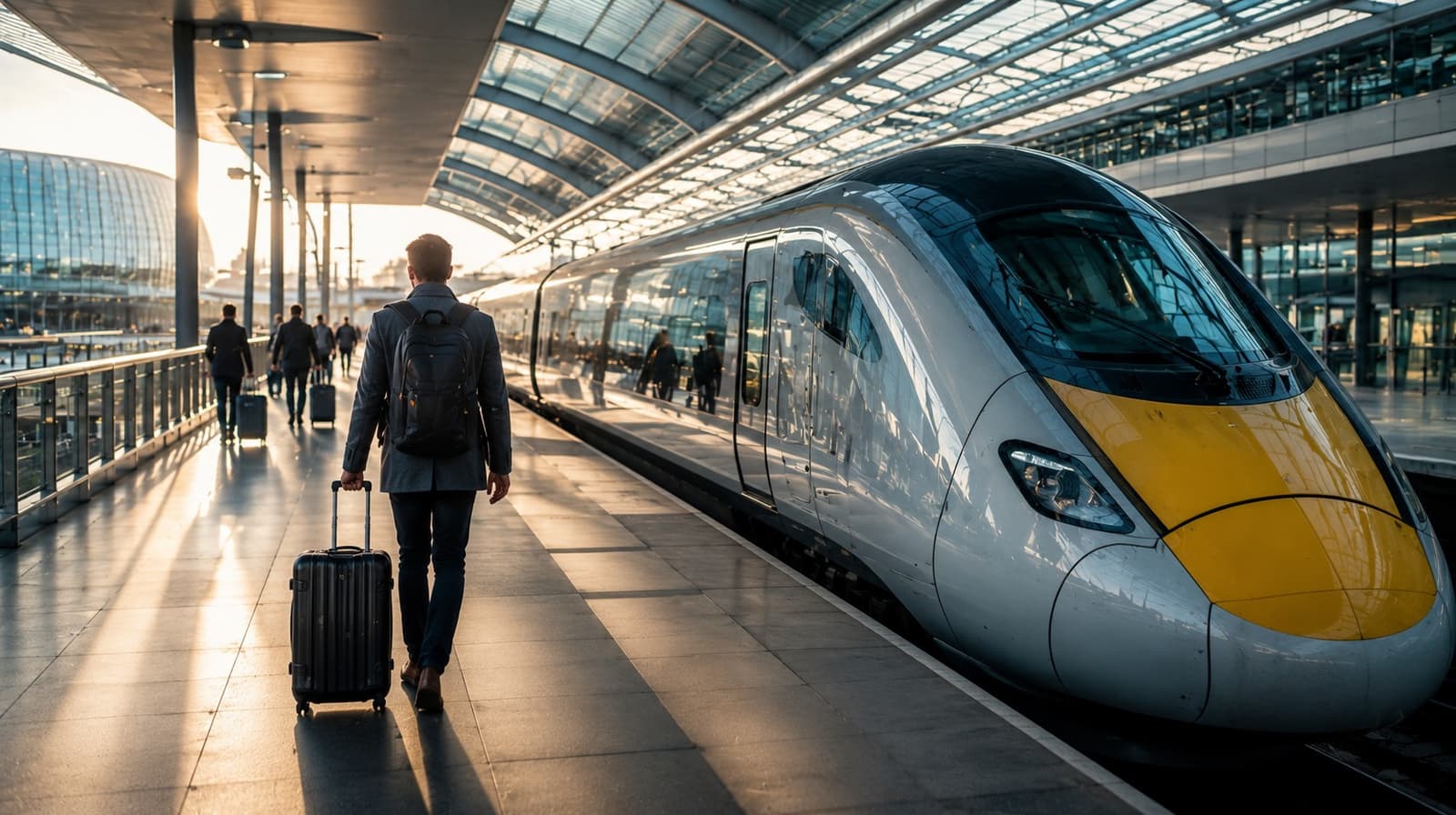
Eurostar runs from St Pancras International to Gare du Nord in roughly 2 hours 15 minutes, city centre to city centre, with no airport at either end. That last point is what makes it beat flying on almost every measure that matters: no transfer to a distant terminal, no three-hour check-in ritual, and you arrive in the 10th arrondissement rather than in a field 25 kilometres outside town.
The catch is the ends. St Pancras wants you there well before departure, and Gare du Nord is a large, busy station where the taxi queue is a genuine event. Getting to and from the stations with luggage is where the trip either flows or does not.
Getting to Paris: the road
Driving is the other option and it is better than people assume, particularly for groups and for anyone with real luggage. Le Shuttle carries vehicles from Folkestone to Calais in about 35 minutes, and you stay with your car throughout, which means no baggage handling at all. London to Paris by road runs to roughly six hours door to door including the crossing.
The case for it is specific rather than general. For one person with a bag, take the train. For four people with luggage, or for anyone who wants to stop at Reims or in Picardy on the way, or who is carrying things that would be awkward on a train, the car wins clearly. It is also the only option that puts you in one seat from your front door to your Paris hotel with nothing carried in between.
Our London to Paris driving service covers the whole run including the crossing, and city to city journeys handles the wider European routes. For groups, the V-Class at £140 and Vito at £130 take people and luggage together, with fares from £80. See what each vehicle holds before splitting a group across cars.
Where you actually can see it from
Since the London answer is no, the useful list is the Paris one. The classic view is from the Trocadéro, across the river on the Right Bank, which gives the tower head-on with the Seine in front. It is the photograph everybody takes and it is genuinely the best angle.
The Champ de Mars puts you at its feet looking up, which is the view that conveys the scale, and the tower is much bigger than photographs suggest. Montmartre and the steps of Sacré-Cœur give you the city with the tower in it rather than the tower alone. And the Tour Montparnasse observation deck has the best claim of all, on the grounds that it is the one view of Paris that includes the Eiffel Tower and excludes the Tour Montparnasse.
From 344 kilometres away in London, though, the honest answer stands. The planet is in the way.
Can you see the Eiffel Tower from London?
No. Paris is roughly 344 kilometres from London and the maximum possible sightline is about 121 kilometres, combining the tower's 330 metre height with a viewer standing on the Shard. The Earth's curvature blocks it by a factor of nearly three. No weather condition, telescope or vantage point in Britain changes this.
How far is the Eiffel Tower from London?
About 344 kilometres, or 214 miles, in a straight line from central London to the Champ de Mars. By Eurostar the journey is roughly 2 hours 15 minutes from St Pancras to Gare du Nord, and by road it is about six hours door to door including the Channel crossing.
Can you see the Eiffel Tower from the Shard?
No. The Shard's viewing gallery sits at roughly 244 metres, giving a horizon of about 56 kilometres. Adding the Eiffel Tower's own 65 kilometre horizon produces a maximum sightline of about 121 kilometres, which leaves you 223 kilometres short of Paris. The Shard is the tallest building in the United Kingdom and it is nowhere near tall enough.
How high would you need to be to see the Eiffel Tower from London?
About 6,100 metres, which is roughly 20,000 feet. At that altitude your horizon reaches 279 kilometres, and the tower's own 65 kilometres closes the remaining gap. A passenger jet cruises higher still, at around 35,000 feet, so the sightline works geometrically from an aircraft even though haze usually defeats it in practice.
Would a really clear day help?
No, and this is the common misunderstanding. The obstruction is the ground, not the air. Removing all haze would not let you see through several kilometres of solid planet, any more than clear air lets you see through a mountain. Atmospheric refraction bends light around the curve by roughly 7 to 8 per cent, which is a rounding error against a gap this large.
What English tower looks like the Eiffel Tower?
Blackpool Tower, opened in 1894 and directly modelled on it at roughly half scale, standing 158 metres tall. It is red rather than brown and sits atop a building rather than on open ground, but the resemblance is deliberate and it accounts for most reported sightings of an Eiffel Tower in England.
Did London ever have its own Eiffel Tower?
Almost. Watkin's Tower at Wembley Park was begun in 1892 by the railway magnate Sir Edward Watkin, intended to reach around 358 metres and beat Paris. Boggy ground and vanishing funds stopped it at about 47 metres, it was nicknamed Watkin's Folly, and it was demolished in 1907. Wembley Stadium now occupies the site.
How tall is the Eiffel Tower?
330 metres including its antennas, from an original height of about 300 metres when it was completed in 1889 for the Exposition Universelle. Gustave Eiffel's company built it, and it remained the tallest man-made structure in the world until the Chrysler Building overtook it in 1930.
Is the train or the car better for London to Paris?
The train wins for one or two people travelling light, at 2 hours 15 minutes city centre to city centre with no airport at either end. The car wins for groups, for heavy luggage, and for anyone wanting to stop on the way, since Le Shuttle takes 35 minutes and you never handle a bag. Door to door by road is about six hours.
How long is the Channel Tunnel?
50.45 kilometres, of which 37.9 run under the seabed, making it the longest undersea section of any tunnel in the world. It opened in 1994. Le Shuttle carries vehicles from Folkestone to Calais in roughly 35 minutes, with passengers staying in their cars.
Where is the best place to see the Eiffel Tower in Paris?
The Trocadéro, on the Right Bank across the Seine, which gives the tower head-on with the river in front and is the classic photograph. The Champ de Mars puts you underneath it for scale, Montmartre gives you the whole city with the tower in it, and the Tour Montparnasse deck has the only Paris view that excludes the Tour Montparnasse.
Why do people think they have seen the Eiffel Tower in England?
Because Britain built its own copies. Blackpool Tower opened in 1894 as a deliberate half-scale imitation, and Watkin's Tower at Wembley was an abandoned attempt to beat it outright. Between them they account for nearly every reported sighting, and neither is anywhere near London's skyline.
Can you see France from England?
Yes, and this is the comparison that makes the Paris answer intuitive. The Channel is only about 33 kilometres wide at the Strait of Dover, so the French coast is routinely visible from the cliffs on a clear day. That distance sits comfortably inside the horizon limit. Paris, at 344 kilometres, does not.
Is Paris worth a day trip from London?
Yes, and it is genuinely doable. Eurostar makes a day return realistic at roughly 2 hours 15 minutes each way, leaving a full day in the city, though an overnight stay makes far better use of the fare. By road it is about six hours each way, which turns a day trip into a long weekend instead.
How tall is the Shard?
The Shard reaches 310 metres, making it the tallest building in the United Kingdom, with its viewing gallery at roughly 244 metres. That gives a horizon of about 56 kilometres, which is why it cannot see Paris and why no taller British building would fix the problem either.
Can you drive from London to Paris in a chauffeur car?
Yes. The route runs via Folkestone and Le Shuttle to Calais, then on to Paris, roughly six hours door to door. You stay in the same car throughout, so nothing is carried or checked in, which is the main advantage over the train for groups or anyone with substantial luggage.