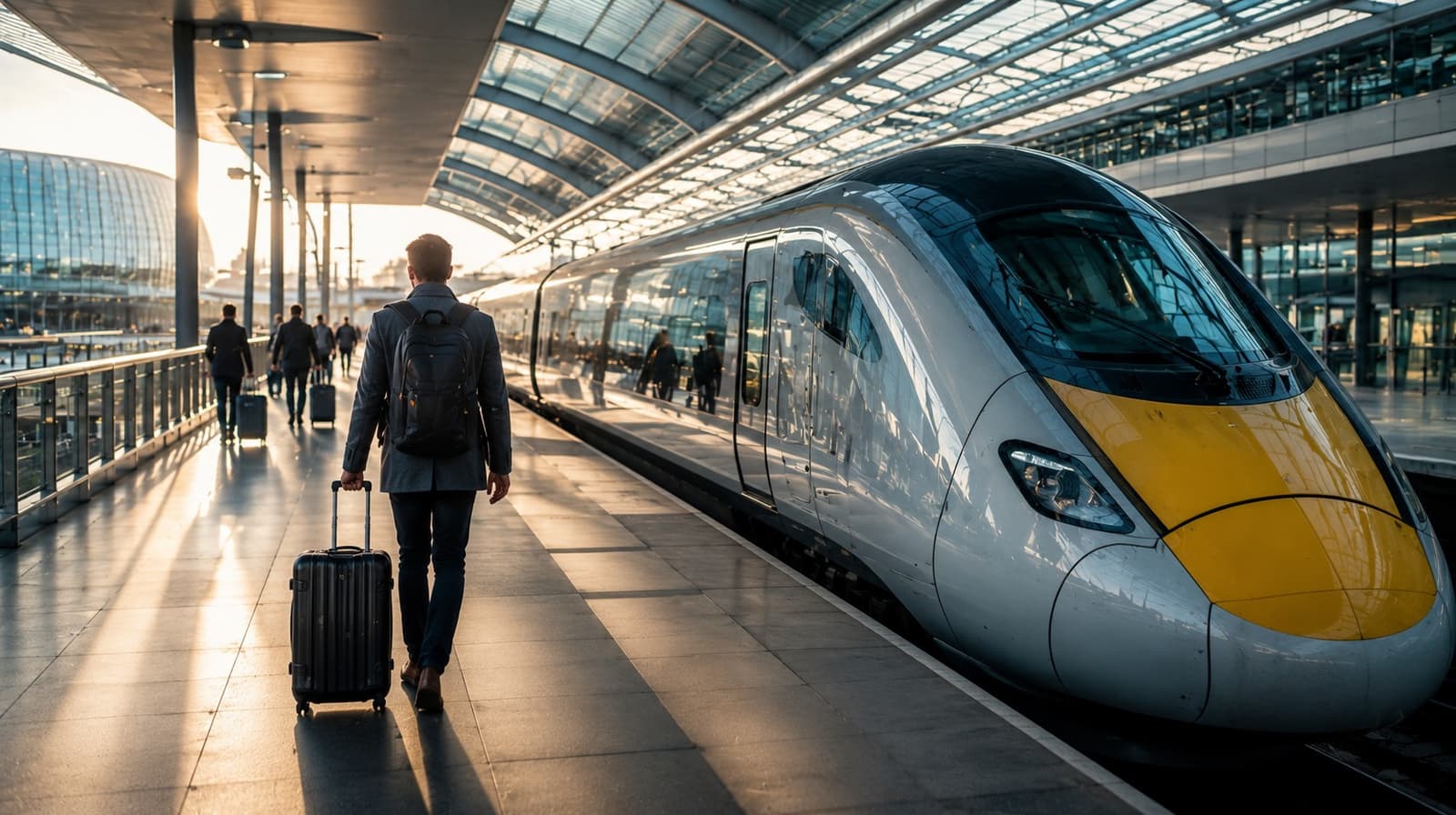
Landing at Heathrow after a long flight is the point at which a journey either finishes smoothly or becomes an hour of low-grade stress. You are tired, your phone may have no signal, you have luggage, and somewhere out there is supposed to be a car. Most people's experience of this is a phone call made one-handed in a crowded hall, followed by a walk to a car park they have never seen before. It does not have to work that way, and the alternative has a name that is used so loosely it has stopped meaning much. This guide explains exactly what a meet and greet arrival involves at Heathrow, in the order it happens, from the flight number you hand over at booking to the moment the boot closes. It covers what your driver is doing while you are still queueing at passport control, where they stand in each of the four terminals, what the free waiting period actually covers, and what to do if something goes wrong.
What the term should mean
Meet and greet means your driver leaves the car, pays to park, walks into the terminal building and waits in the arrivals hall holding a board with your name on it. That is the whole definition, and the important part is the word inside. The alternative, which many companies also describe as meet and greet, is a kerbside pickup: the driver stays with the vehicle, cannot legally wait outside a terminal for long, and rings you when you emerge, having circled the airport in the meantime. The difference is not a matter of degree. In one, someone is standing still, in a fixed place, holding your name, when you walk out. In the other, you are looking at your phone trying to work out which of several roads and levels the car is on. When you compare quotes, this is one of the more common places a lower price is achieved, so it is worth asking directly which of the two is being offered.
Before you land: what your driver is doing
The work starts before the aircraft does. When you book, we ask for a flight number rather than an airline, and the reason is practical: the flight number identifies the specific arrival, which tells us the terminal and, more usefully, lets us track the aircraft. Your driver follows the actual progress of the flight rather than the schedule printed on your ticket, which is why a delay does not require you to do anything and does not cost anything either. The aim is for the driver to be inside the terminal before the aircraft is on stand. That means leaving with a margin that is often unused, driving to the airport, parking in a short stay car park and paying for it, then walking to the arrivals hall. All of that happens while you are still taxiing. By the time you reach the aircraft door, the person collecting you is already standing in the right place.
Which terminal, and where exactly
Heathrow has four operating passenger terminals, and they are far enough apart that the wrong one costs real time. Terminal 1 closed in 2015, so anything referring to it is out of date. Terminal 2, the Queen's Terminal, handles most Star Alliance carriers. It operates as a main building with a satellite, T2B, joined underground, but all arriving passengers funnel into a single arrivals hall, so the satellite makes no difference to where you are met. Terminal 3 carries the most mixed airline list at the airport, with carriers from several alliances, which is precisely why the flight number matters more here than anywhere else. Terminal 4 sits apart on the south side with its own road access and its own Underground station, and there is no walking route to the central terminals. Terminal 5 is at the western end, used almost entirely by British Airways and Iberia, and reached by a dedicated spur from the M25. Whichever you arrive at, your driver waits in that terminal's own arrivals hall, near the exit from customs. Full details of each are on our Heathrow airport transfers page.
The gap nobody plans for
Between the aircraft door and the arrivals hall lies a stretch of time that is almost impossible to predict, and it is the single biggest reason airport pickups go wrong. Passport control can take a few minutes or the better part of an hour depending on the hour, the terminal and how many wide-body aircraft landed at once. Baggage reclaim then adds an unpredictable wait of its own, and a long-haul arrival with a full hold is slower than a short European flight with hand luggage. This is why the free waiting period on an airport booking runs from touchdown rather than from your scheduled arrival time or from when the driver got there. Sixty minutes measured from the moment the wheels touch is a window designed around the real shape of an arrival. A waiting period that started when you were supposed to land would be worth very little, because the queue is what consumes it.
The moment you come through
You walk out of customs into the arrivals hall, and the driver is standing near the exit holding a board with your name. They stay in the hall rather than wandering, which sounds obvious but matters: a person moving around a crowded space is far harder to find than one standing still. From there the sequence is short. They take the heavy cases rather than the light ones, confirm the destination, and walk you to the car, which is in a nearby short stay car park rather than a distant one. If you need a few minutes for a coffee, a phone call or a change of clothes, say so; the car is not going anywhere and this is a normal request rather than an imposition. The parking charge and the walking time are already inside the fare you agreed at booking, so nothing is settled on the day and there is no meter running while you finish your call.
How it compares with the alternatives
Heathrow is unusually well served by public transport, so it is worth being straight about when a car is the better answer and when it is not. The Heathrow Express reaches Paddington in about fifteen minutes and is genuinely fast, but it only goes to Paddington, which is on the western edge of the centre. If your destination is anywhere else, you are adding a second leg with your luggage, and that leg is the part people underestimate. The Elizabeth line is cheaper and reaches further east including Canary Wharf, at the cost of more stops. The Piccadilly line is cheapest and slowest, and involves stairs at a number of stations. For a single traveller with a cabin bag heading to a station on one of those lines, rail frequently wins on both time and cost, and we would say so. The car wins when there are two or more of you, when there is real luggage, when you are arriving at an hour you would rather not navigate a connection, when the destination is not near a station, or when the day ahead means arriving composed matters. It also wins whenever the alternative involves changing trains while holding a case in each hand.
What it costs, and why it is included
On our bookings, meeting you inside is applied automatically to every airport arrival rather than sold as an extra, and the reason is straightforward: charging separately for it creates an incentive to quote a low headline price and hope you do not notice what is missing. The driver's parking is inside the fare, the waiting time is inside the fare, and the fare itself is fixed when you book, so heavy traffic on the M4 does not change it and there is no surge pricing at busy hours. When comparing operators, the questions that reveal the real price are these: is the driver inside the terminal or at the kerb, is parking included or added, when does free waiting start, and what happens if the flight is delayed. A quote that looks better on the surface frequently answers one of those badly, and the difference appears after you have travelled rather than before.
Arriving with a group, or with children
A group changes the arithmetic in a way that favours being met inside considerably. Four people emerging from customs in a busy hall do not stay together, and coordinating everyone towards a car park by phone is markedly harder than coordinating one person. A driver holding a board is a fixed point that the whole party can be told to head for before the flight even lands, which removes the milling about entirely. With children the case is stronger again. Families move slowly through immigration, arrive with more luggage than the passenger count suggests, and are least able to cope with a phone call in a noisy hall. The free waiting period measured from touchdown does real work here, since a family with a pushchair takes longer through every stage than a business traveller with a cabin bag. Tell us the ages when you book so any child seats are fitted before the car leaves, because they cannot be added once the driver is on the way, and mention the pushchair explicitly since a folded pram occupies roughly the space of a large suitcase. We cover this in more detail in our guide to travelling with children and child seats.
Departures work in reverse
The same booking runs the other way, with a different emphasis. There is no board involved on a departure. The car collects you from your home or office and sets you down at your own terminal's departures entrance rather than a shared drop-off point, which saves a walk with luggage that is more tiring than it sounds. Timing is worked backwards from the airline's check-in deadline rather than from the flight time, with a margin built in for the approach roads. One detail is worth checking the week you fly rather than the month you book: airlines are occasionally reassigned between terminals, so a terminal printed on an older booking may no longer be right. Your boarding pass is what settles it, and telling us of a change costs nothing.
When something goes wrong
Occasionally it does, and knowing the plan in advance takes the anxiety out of it. If you cannot see your driver, ring the number on your confirmation immediately rather than searching. Drivers stay in the arrivals hall, so in practice you are usually looking for a board within a few paces of the customs exit, but a phone call resolves it in under a minute and we would far rather you rang straight away. If your flight is diverted to another airport, tell us as soon as you have signal. It becomes a different journey and it is not free, but it is a great deal simpler than finding transport from an unfamiliar airport at short notice. If you are held up beyond the free waiting period, the driver does not disappear; waiting continues at an agreed rate and nobody abandons you. And if you are travelling with someone else, or arranging a collection for a client or a relative, give us their name for the board and a contact number, and we will confirm to you once they are in the car. The same arrangements apply at every airport we cover, as set out on our airport meet and greet page.
What to have ready when you book
Four things make the difference between a smooth arrival and a series of messages. The flight number, which identifies the terminal and lets us track the aircraft. The name that should appear on the board, which matters if you are meeting a client or a relative rather than travelling yourself. The full destination address including a postcode, since a district name is not enough to plan an approach. And the passenger and luggage counts as separate figures, because the cases decide the vehicle more often than the seats do. A mobile number that will work on landing is worth adding, and if yours will not have signal until you clear customs, tell us so and we will not read the silence as a problem.
What is meet and greet at Heathrow?
Your chauffeur parks, walks into the terminal and waits in the arrivals hall holding a board with your name. They then take the luggage and walk you to the car. It is different from a kerbside pickup, where the driver stays outside and finds you by phone after you have already come through.
Where will my driver be waiting?
Inside your terminal's arrivals hall, near the exit from customs. Each Heathrow terminal has its own separate hall, which is why we ask for a flight number rather than an airline. The driver stays in one place rather than moving around, so the board is usually visible within a few paces.
How long will the driver wait after landing?
Up to 60 minutes from touchdown at no charge. The window runs from the moment the aircraft lands rather than from your scheduled arrival, because passport control and baggage reclaim are what consume the time. Beyond that, waiting continues at an agreed rate rather than the driver leaving.
What happens if my flight is delayed?
Nothing, and nothing extra is charged. Your driver holds the flight number and follows the live landing time, so a delayed arrival simply means a later meeting. An early landing usually means the board is already up when you walk out.
Is there a charge for the driver's parking?
No, it is inside the fare. Heathrow charges vehicles to enter and to use its car parks, and that cost is accounted for in the price you agree at booking. The figure quoted is the figure you pay, with nothing to settle on the day.
Which Heathrow terminals do you cover?
All four: Terminals 2, 3, 4 and 5. Terminal 1 closed in 2015. There is no price difference between terminals, since the fare is set by where you are going rather than where you land. Terminal 4 and Terminal 5 are at opposite ends of the airport, so the right one matters.
What if my flight arrives at a different terminal than booked?
Tell us as soon as you know and the driver is redirected at no cost. Airlines are reassigned between terminals periodically, so a terminal printed on an older booking is worth rechecking the week you fly. Your boarding pass is what settles it.
Can you meet someone travelling without me?
Yes, and it is common for clients, colleagues and relatives. Give us their name for the board and a contact number, and we will confirm to you once they are in the car. It is a straightforward way to look after an arriving guest who does not know the airport.
What should I do if I cannot find my driver?
Ring the number on your confirmation immediately rather than searching. We will put you in direct contact within a minute or two. Drivers remain in the arrivals hall rather than moving about, so the board is nearly always closer than it feels in a crowded terminal.
Do departures work the same way?
They reverse it, with no name board involved. The car collects you from your address and sets you down at your own terminal's departures entrance rather than a shared drop-off. Timing is worked backwards from the airline's check-in deadline rather than from the flight time.